
How an mRNA vaccine is made: from a DNA template to the lipid particle in the vial
The molecule, the enzyme that copies it, the fat that carries it, and why it has to be kept frozen
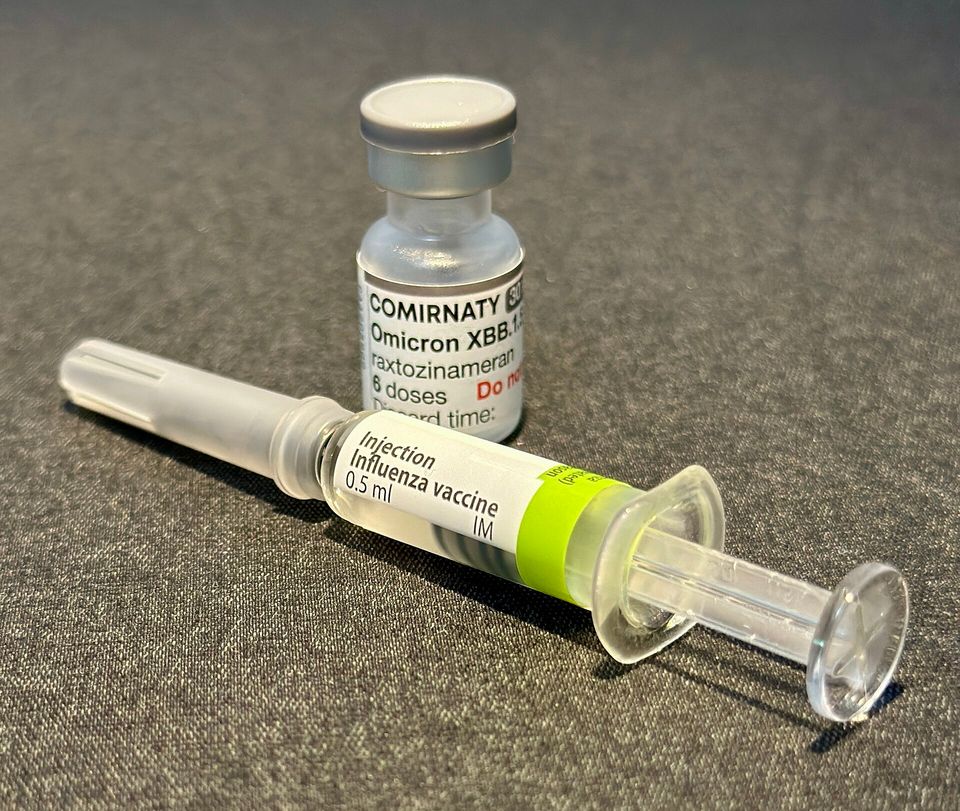
An mRNA vaccine contains no virus, only the instructions for one of its proteins, written in the cell's own messenger molecule. Making it is a chemistry of enzymes and lipids rather than of cultured cells, which is why it could be designed in days in 2020 and made by the million within a year.
Key points
- An mRNA vaccine delivers RNA encoding a pathogen's protein, for COVID-19 the spike protein, which cells make for a few days before the RNA is degraded.
- Production starts from a DNA plasmid grown in E. coli and cut into a straight template, which T7 RNA polymerase copies into RNA.
- Both COVID-19 mRNA vaccines replace uridine with N1-methylpseudouridine, building on Karikó and Weissman's 2005 work, honoured by the 2023 Nobel Prize.
- The RNA is packaged in lipid nanoparticles about 100 nanometres across, assembled from four lipids, one of them ionisable.
- The original Comirnaty formulation had to be shipped at minus 90 to minus 60 degrees Celsius, and Spikevax at minus 50 to minus 15.
A messenger RNA vaccine delivers to the body's cells a strand of RNA encoding a protein from a pathogen, in the case of the COVID-19 vaccines the coronavirus spike protein. The cells read the strand with the same machinery they use for their own messenger RNA, make the protein for a few days, and the immune system learns to recognise it.
The RNA is then degraded; it does not enter the nucleus and does not alter the cell's DNA, as the European Medicines Agency's product information for Comirnaty and Spikevax states. Two such vaccines, from BioNTech with Pfizer and from Moderna, received their first emergency authorisations in December 2020.
Writing the message
Production starts not with RNA but with DNA: a circular plasmid carrying the gene for the spike protein, grown in *Escherichia coli* bacteria, purified and cut open with a restriction enzyme to make a straight template. An enzyme from a bacterial virus, T7 RNA polymerase, then reads the template and synthesises RNA copies from the four building blocks supplied in the reaction, a process called *in vitro* transcription. It happens in a tank of solution, not in living cells, and a single reaction of a few litres yields enough RNA for millions of doses.
The RNA is not a plain copy of the gene. Both vaccines replace one of the four bases, uridine, with a modified form, N1-methylpseudouridine, a change found by Katalin Karikó and Drew Weissman in work published in 2005 that keeps the strand from triggering the cell's alarm sensors and lets it be translated efficiently; the two shared the 2023 Nobel Prize in Physiology or Medicine for it. A cap is added at one end and a long tail of adenines at the other, as on the cell's own messages, and the template DNA is digested away. The RNA is purified by chromatography to remove fragments and double-stranded by-products.
Wrapping it in fat
Naked RNA would be destroyed in the blood within minutes and could not cross a cell membrane. The strand is therefore packaged into a lipid nanoparticle about 100 nanometres across, made by mixing the RNA in an acidic solution with four lipids dissolved in ethanol in a microfluidic device, so that they assemble spontaneously. One lipid is ionisable: neutral at the blood's pH but positively charged in the acidic interior of the cell compartment that takes the particle up, which disrupts that compartment and releases the RNA into the cytoplasm. The other three, a phospholipid, cholesterol and a polyethylene-glycol lipid, give the particle its structure and shield it.
The finished particles are concentrated, filtered, tested for RNA integrity, particle size and sterility, and filled into vials. The RNA's fragility sets the storage rules: the EMA's product information required the original Comirnaty formulation to be shipped at minus 90 to minus 60 degrees Celsius, later relaxed for newer formulations, and Spikevax at minus 50 to minus 15.
Why could the vaccines be made so fast?
Because the process is the same whatever protein is encoded, only the DNA template changes from one vaccine to the next. Moderna has stated that its candidate sequence was finalised on 13 January 2020, two days after the virus's genome was published, and BioNTech that it began its programme the same month. Conventional vaccines grown in eggs or cell cultures take months to adapt; the mRNA platform's manufacturing chain was already built for whichever sequence came.
Frequently asked questions
Does an mRNA vaccine change your DNA?
No. The cells read the RNA strand, make the encoded protein for a few days, and then degrade the RNA. It does not enter the nucleus and does not alter the cell's DNA, as the European Medicines Agency's product information for Comirnaty and Spikevax states.
How is the RNA in an mRNA vaccine produced?
A DNA plasmid carrying the spike gene is grown in E. coli bacteria, purified and cut open into a straight template. T7 RNA polymerase then transcribes RNA copies in a tank of solution, not in living cells; a cap and a tail of adenines are added, and the RNA is purified by chromatography.
Why is the RNA wrapped in a lipid nanoparticle?
Naked RNA would be destroyed in the blood within minutes and could not cross a cell membrane. The particle, about 100 nanometres across, shields it, and its ionisable lipid becomes charged inside the cell compartment that takes it up, releasing the RNA into the cytoplasm.
Why could mRNA vaccines be developed so quickly?
The manufacturing process is the same whatever protein is encoded, so only the DNA template changes. Moderna has stated that its candidate sequence was finalised on 13 January 2020, two days after the virus's genome was published, and the production chain was already built.
Sources
- Comirnaty: EPAR, product information and assessment reports
- Spikevax: EPAR, product information and assessment reports
- Press release: The Nobel Prize in Physiology or Medicine 2023
- Scientific background: The Nobel Prize in Physiology or Medicine 2023 (on Karikó and Weissman's nucleoside-modified mRNA)
- COVID-19 Vaccine Basics