
How steel is made in a basic oxygen furnace: 300 tonnes of iron refined in twenty minutes
The Linz-Donawitz process of 1952, the lance, the slag, and why the charge includes scrap
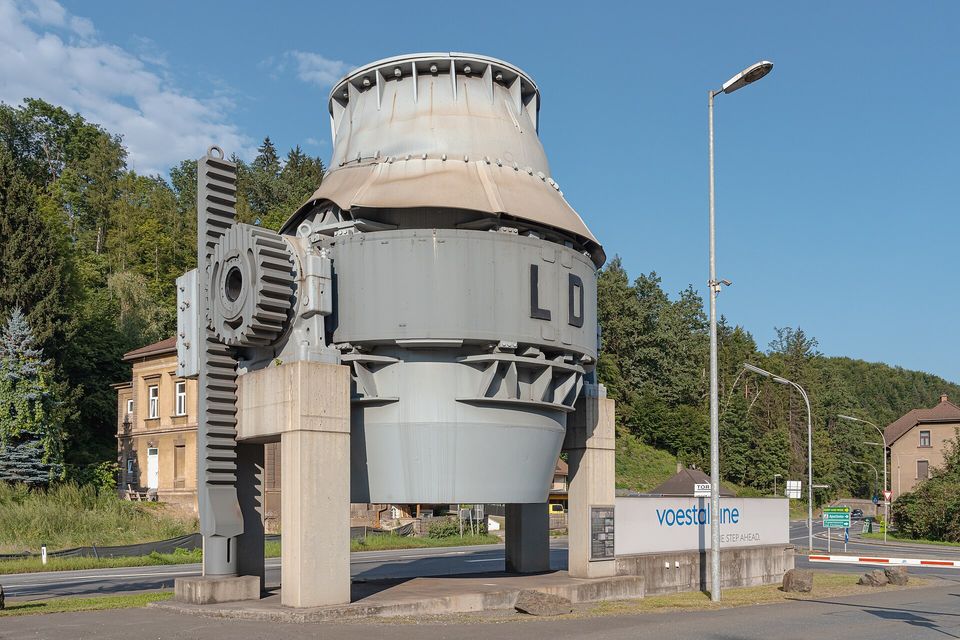
Most of the world's new steel is made by blowing pure oxygen through molten iron. The converter, invented in Austria in the early 1950s, burns the carbon out of a blast-furnace charge in about twenty minutes, and the heat of that burning is what melts the scrap thrown in with it.
Key points
- The basic oxygen furnace, or LD converter, was first run commercially at Linz and Donawitz in Austria in 1952 and 1953.
- The World Steel Association puts the basic oxygen route at about 71 per cent of world crude steel output in 2023.
- Blast-furnace iron holds about 4 per cent carbon; the converter burns it down to a fraction of a per cent with a jet of pure oxygen.
- A converter is charged with roughly one part scrap to three or four parts molten iron, the scrap serving as the coolant.
- The oxygen blow lasts 15 to 20 minutes for a 300-tonne heat and raises the bath from about 1,300 to about 1,650 degrees Celsius.
The basic oxygen furnace, also called the LD converter after the Austrian towns of Linz and Donawitz where it was first run commercially in 1952 and 1953, is the vessel in which most of the world's primary steel is made.
Iron from a blast furnace contains about 4 per cent carbon and smaller amounts of silicon, manganese, phosphorus and sulphur, and is brittle; steel is iron with the carbon brought down to a fraction of a per cent and the other elements controlled. The converter does that by oxidation, using a jet of pure oxygen, and it does it fast. The World Steel Association's statistics put the basic oxygen route at about 71 per cent of world crude steel output in 2023, with electric arc furnaces melting scrap making up most of the rest.
The charge
The vessel is a pear-shaped steel shell lined with refractory bricks, typically magnesia-carbon, tilted on trunnions so that it can be tipped to be filled and emptied. The name's basic refers to that lining and to the slag, which are chemically basic to absorb the acidic phosphorus and silicon oxides. A heat begins with the converter tilted towards the charging side: steel scrap goes in first, then molten iron poured from a ladle, in a proportion of roughly one part scrap to three or four parts hot metal. The scrap is not there only to be recycled; it is the coolant. The reactions to come release so much heat that without it the bath would overheat.
What happens during the oxygen blow?
The vessel is righted and a water-cooled lance is lowered to a metre or so above the bath. Through nozzles at its tip it blows oxygen at supersonic speed, at a rate that a plant like voestalpine's at Donawitz measures in hundreds of cubic metres a minute. The oxygen reacts first with silicon and manganese, then with carbon, which leaves as carbon monoxide in a torrent of gas and sparks that is captured, cleaned and often burned for energy. Lime and dolomite are added to form a slag that floats on the metal and takes up the phosphorus and the oxides. The temperature rises from about 1,300 degrees Celsius at charging to about 1,650 at the end. The whole blow lasts between 15 and 20 minutes for a 300-tonne heat, a figure that the industry's technical references give as typical for a modern shop.
Samples are taken, by a sub-lance dipped into the bath during the blow and by hand at the end, and analysed within a minute or two for carbon and temperature. If the numbers are right, the vessel is tilted the other way and the steel is tapped through a hole in its side into a ladle, the slag held back by the geometry of the tilt and by a plug fired into the taphole. The slag is then poured off separately into a pot.
After the converter
The steel in the ladle is not finished. Alloying elements are added as it tapped, and at a ladle furnace or a vacuum degassing station its composition and temperature are adjusted, sulphur removed and dissolved gases drawn off. From there it goes to a continuous caster, where it solidifies into slabs, blooms or billets for rolling. A converter shop runs its vessels in rotation, one blowing while another is tapped and a third relined, and a large plant makes a heat every half hour around the clock.
Frequently asked questions
What is a basic oxygen furnace?
It is a pear-shaped, tilting steel vessel lined with refractory bricks in which molten blast-furnace iron is turned into steel by blowing pure oxygen through it. Also called the LD converter after Linz and Donawitz, it makes most of the world's primary steel.
Why is scrap added to the converter?
Scrap is the coolant. The oxidation reactions release so much heat that without it the bath would overheat, so steel scrap goes in first, in a proportion of roughly one part scrap to three or four parts molten iron.
How long does it take to make a heat of steel?
The oxygen blow lasts between 15 and 20 minutes for a 300-tonne heat, and a large plant running its converters in rotation, one blowing while another is tapped and a third relined, makes a heat every half hour around the clock.
What happens to the steel after the converter?
It is tapped into a ladle, where alloying elements are added; at a ladle furnace or a vacuum degassing station its composition and temperature are adjusted and sulphur and dissolved gases removed. It then goes to a continuous caster to solidify into slabs, blooms or billets.