
An instrument in a page: the Argo array, 4,000 robots taking the ocean's temperature every ten days
Part three of six. A float that drifts at depth, rises to the surface to report, and belongs to no one country
The Argo array is an instrument made of thousands of identical instruments. Each float sinks to two kilometres, drifts, and surfaces every ten days to send a profile of temperature and salinity by satellite. Together they have measured, for the first time, how much heat the ocean is storing.
Key points
- Argo deployed its first floats in 1999 and reached its target of 3,000 active floats in November 2007; around 4,000 operated in the mid-2020s.
- An Argo float changes depth by pumping oil between an internal reservoir and an external bladder, altering its volume but not its mass.
- The standard cycle drifts at 1,000 metres for about nine days, sinks to 2,000 metres, then rises over some six hours, measuring as it goes.
- All Argo data are public within 24 hours, and more than 2.5 million profiles have been collected since the start.
- Argo-based analyses cited by the IPCC show the ocean has absorbed about 90 per cent of the extra heat trapped by greenhouse gases.
Argo is an international array of autonomous profiling floats that measure the temperature and salinity of the upper two kilometres of the ocean. The programme was proposed in 1998, its first floats were deployed in 1999, and it reached its design target of 3,000 active floats in November 2007.
The Argo programme's own status pages count around 4,000 operational floats in the mid-2020s, contributed by about 30 countries, and more than 2.5 million profiles collected since the start. All the data are public within 24 hours of being received. The name comes from the ship of Jason in the Greek myth, chosen because the array was designed to work with the Jason satellite altimeters.
How does an Argo float work?
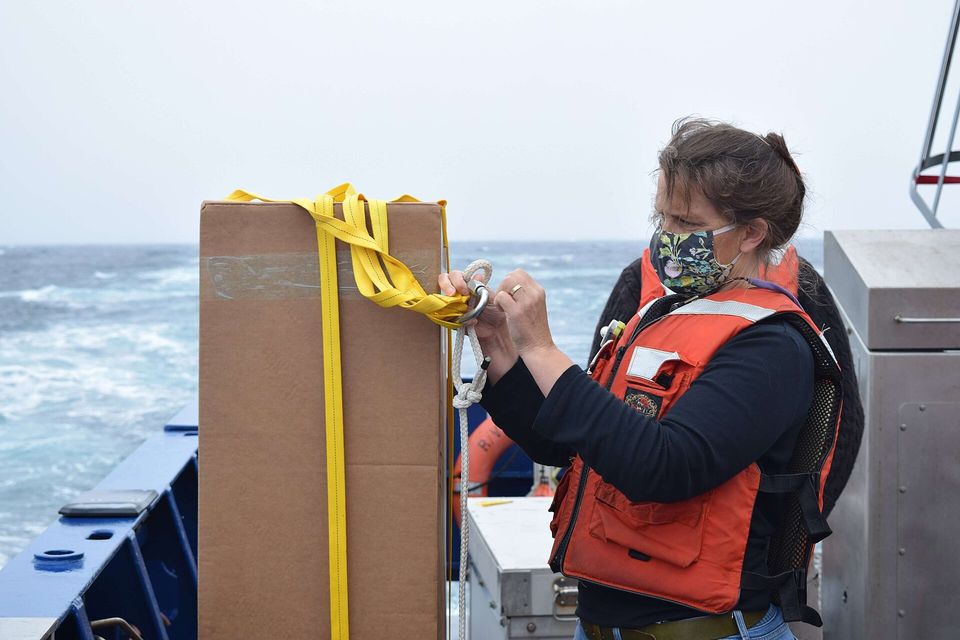
A standard Argo float is a cylinder about two metres long including its antenna, weighing some 25 to 40 kilograms, that a ship's crew or a volunteer vessel simply drops over the side; the photograph shows one being prepared on deck. It has no propeller. It changes its depth by changing its buoyancy: a small pump moves oil between an internal reservoir and an external bladder, altering the float's volume without changing its mass, so that it sinks or rises. The standard cycle, set in the programme's design documents, is to descend to a parking depth of 1,000 metres, drift with the current for about nine days, sink to 2,000 metres, and then rise to the surface over some six hours, measuring temperature, salinity and pressure with a CTD sensor as it goes. At the surface it fixes its position by GPS, transmits the profile by satellite, and sinks again. A float completes about 150 such cycles over four to five years before its battery is exhausted, and it is not recovered.
The floats are built by a handful of manufacturers to the same specification, in France, the United States and elsewhere, and their sensors are calibrated before launch and checked afterwards against ship measurements and against each other, because salinity sensors drift. The array is kept full by a steady rate of new deployments, about 800 a year, planned so that the floats stay spread across the oceans at roughly one per three degrees of latitude and longitude.
What it found
Before Argo, the ocean below the surface was measured mainly from research ships and from expendable probes dropped along shipping lanes, which left the Southern Hemisphere and the winter months almost blank. Argo's first achievement was coverage: a complete picture of the upper ocean's temperature every ten days, in every season. From that came the central number in the study of the Earth's energy balance. Argo-based analyses, cited in the Intergovernmental Panel on Climate Change's Sixth Assessment Report, show that the ocean has absorbed about 90 per cent of the extra heat trapped by greenhouse gases, and give the rate at which its heat content is rising with an uncertainty small enough to detect the trend from year to year. The array also mapped the ocean's salinity, showing the salty regions growing saltier and the fresh regions fresher as the water cycle intensifies.
The programme is now extending its reach. Deep Argo floats profile to 6,000 metres, and BGC-Argo floats carry sensors for oxygen, nitrate, pH, chlorophyll and light, with a target of 1,000 such floats to measure the ocean's chemistry and biology the way the core array measures its physics.
Frequently asked questions
How does an Argo float move up and down?
It has no propeller. A small pump moves oil between an internal reservoir and an external bladder, changing the float's volume without changing its mass, so that it sinks or rises.
What does an Argo float measure?
Temperature, salinity and pressure, measured with a CTD sensor as it rises from 2,000 metres to the surface every ten days. At the surface it fixes its position by GPS, sends the profile by satellite and sinks again; Deep Argo and BGC-Argo floats go deeper or add chemical sensors.
How long does an Argo float last?
About 150 cycles over four to five years, until its battery is exhausted; it is not recovered. Some 800 new floats a year keep the array full, spread at roughly one per three degrees of latitude and longitude.
What has Argo revealed about the ocean?
A complete picture of the upper ocean every ten days, in every season, and the central number of the Earth's energy balance: the ocean has absorbed about 90 per cent of the extra heat trapped by greenhouse gases. It also shows salty regions growing saltier and fresh regions fresher.
Sources
- About Argo
- How do floats work
- Argo implementation status
- D. Roemmich et al., On the Future of Argo: A Global, Full-Depth, Multi-Disciplinary Array (2019)
- IPCC Sixth Assessment Report, Working Group I, Chapter 2: Changing State of the Climate System
- IPCC Sixth Assessment Report, Working Group I, Chapter 7: The Earth's Energy Budget, Climate Feedbacks, and Climate Sensitivity