
An instrument in a page: the Hubble Space Telescope, a 2.4-metre mirror above the air since 1990
Part one of six. What it measures, how it was built and repaired, and what it found
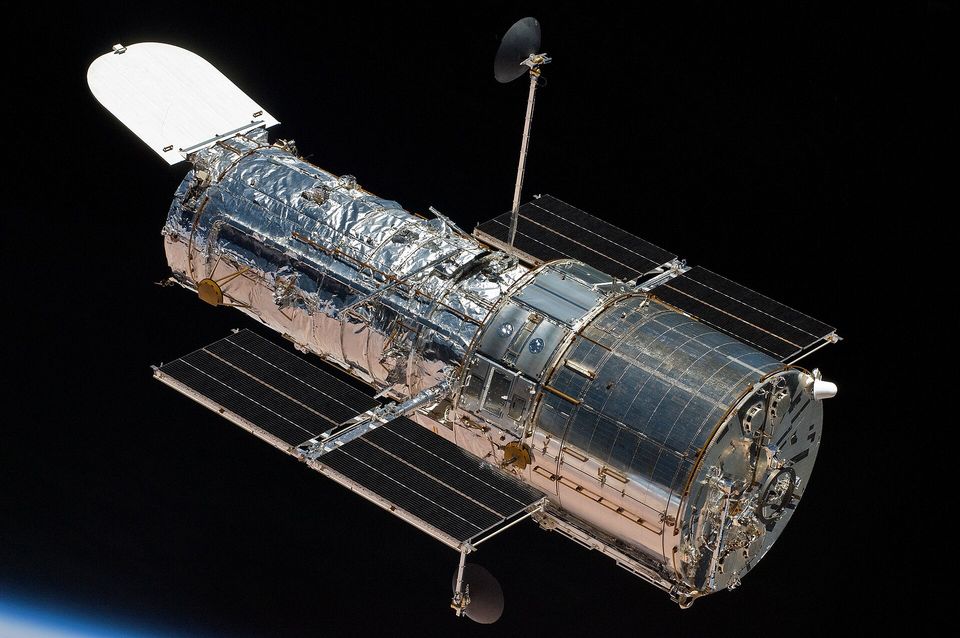
Hubble is the first of six instruments in this series. It is not the largest telescope, but it sits above the atmosphere, and five Shuttle visits kept it current for a quarter of a century. Its measurements fixed the age of the universe and found that its expansion is speeding up.
Key points
- Hubble's primary mirror is 2.4 metres across; the telescope was released from the Space Shuttle Discovery on 25 April 1990.
- Hubble's mirror edge had been ground too flat by about two micrometres; the first servicing mission, in December 1993, corrected the blur.
- Four more Shuttle servicing missions, the last in May 2009, replaced every instrument, the gyroscopes, the batteries and the solar arrays.
- The Key Project measured the Hubble constant in 2001 at 72 kilometres per second per megaparsec, with an uncertainty of about 10 per cent.
- The Hubble Deep Field of 1995, ten days of exposure on a blank patch of sky, showed some 3,000 galaxies.
The Hubble Space Telescope is a reflecting telescope with a primary mirror 2.4 metres across, in orbit about 540 kilometres above the Earth, operated for NASA and the European Space Agency by the Space Telescope Science Institute in Baltimore. It was carried into orbit by the Space Shuttle Discovery and released on 25 April 1990.
Its instruments record ultraviolet, visible and near-infrared light, from about 100 nanometres to 2.5 micrometres, according to the institute's instrument handbooks. Its purpose is not to see further than telescopes on the ground, which have larger mirrors, but to see sharper: above the atmosphere there is no turbulence to blur the image, and no air to absorb the ultraviolet.
How it was built
The telescope is a tube 13.2 metres long and 4.2 metres across, the size of a bus, weighing about 11 tonnes at launch, figures from NASA's mission pages. Its mirror was ground by Perkin-Elmer in Connecticut; the spacecraft was built by Lockheed in California. The design was fixed by the Shuttle: the telescope had to fit its cargo bay, and it was built to be serviced by astronauts, with instruments in standard boxes that could be pulled out and replaced. That decision saved it. The first images in 1990 were blurred, and the cause was found to be spherical aberration: the mirror's edge had been ground too flat by about two micrometres, because a test instrument had been assembled with a spacer in the wrong place. The first servicing mission, in December 1993, installed corrective optics, COSTAR, and a new camera with the correction built in, and the images became what had been promised.
Four more Shuttle missions followed, in 1997, 1999, 2002 and May 2009, replacing every instrument, the gyroscopes, the batteries and the solar arrays. The photograph shows the telescope as it was released after the last of them, from Atlantis. The Shuttle's retirement in 2011 ended the visits; the telescope now flies on the hardware it was left with, its gyroscopes managed carefully, and NASA's projections give it into the 2030s before its orbit decays.
What has Hubble discovered?
Hubble's founding task, written into its name, was to measure the rate at which the universe expands, the Hubble constant, by finding the distances to galaxies with the variable stars called Cepheids. The Key Project team published its result in 2001: 72 kilometres per second per megaparsec, with an uncertainty of about 10 per cent, settling a dispute that had spanned a factor of two. Later Hubble work led by Adam Riess has tightened that figure to about 73, with an uncertainty of about 1 per cent, and the persistent gap between it and the value inferred from the early universe's microwave background is now one of cosmology's open problems.
In 1998 two teams using Hubble among other telescopes to observe distant supernovae found that the expansion is accelerating, work that brought Riess, Saul Perlmutter and Brian Schmidt the 2011 Nobel Prize in Physics. The Hubble Deep Field of 1995, ten days of exposure on a blank patch of sky, showed some 3,000 galaxies and set the method of staring at nothing that its successors follow. The telescope measured the masses of the black holes at the centres of galaxies and watched the fragments of a comet strike Jupiter in 1994. By the institute's count it has produced more than 1.6 million observations and about 21,000 peer-reviewed papers.
Frequently asked questions
Why put a telescope in space?
Not to see further than telescopes on the ground, which have larger mirrors, but to see sharper: above the atmosphere there is no turbulence to blur the image and no air to absorb the ultraviolet. Hubble records ultraviolet, visible and near-infrared light.
What went wrong with Hubble's mirror?
The first images in 1990 were blurred by spherical aberration: the mirror's edge had been ground too flat by about two micrometres, because a test instrument had been assembled with a spacer in the wrong place. Corrective optics installed in December 1993 restored the promised images.
What are Hubble's most important discoveries?
It measured the expansion rate of the universe, the Hubble constant, now to about 1 per cent; it helped show in 1998 that the expansion is accelerating, work honoured by the 2011 Nobel Prize in Physics; and its Deep Field and black-hole measurements changed how astronomers survey galaxies.
How long will Hubble keep working?
The Shuttle's retirement in 2011 ended the servicing visits, so the telescope flies on the hardware it was left with, its gyroscopes managed carefully. NASA's projections give it into the 2030s before its orbit decays.
Sources
- About Hubble: facts and figures
- Astronaut Missions to Hubble
- HST User Documentation: instrument handbooks
- W. L. Freedman et al., Final Results from the Hubble Space Telescope Key Project to Measure the Hubble Constant (Astrophysical Journal, 2001)
- A. G. Riess et al., A Comprehensive Measurement of the Local Value of the Hubble Constant with 1 km/s/Mpc Uncertainty (Astrophysical Journal Letters, 2022)
- The Nobel Prize in Physics 2011
- The Hubble Space Telescope Optical Systems Failure Report (1990)