
An instrument in a page: the Large Hadron Collider, 27 kilometres of magnets under the Geneva plain
Part two of six. A ring built in a tunnel dug for an earlier machine, and the particle it was built to find
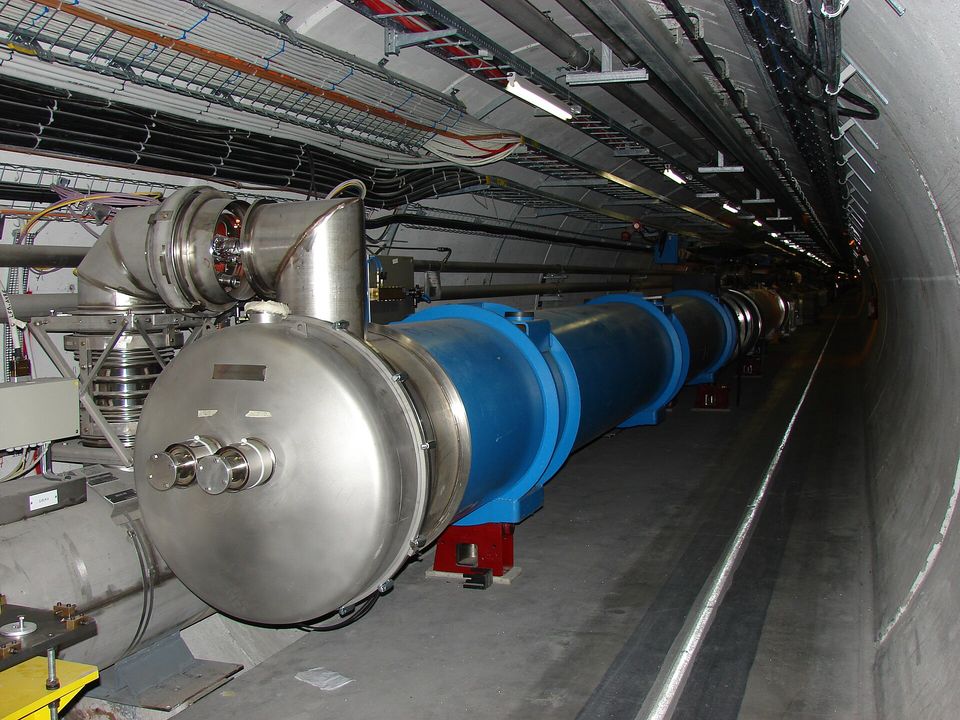
The LHC accelerates protons to within a few metres per second of the speed of light and smashes them together 40 million times a second inside four detectors. Its 1,232 superconducting dipoles are colder than outer space, and in 2012 they delivered the Higgs boson.
Key points
- The LHC lies in a 26.7-kilometre tunnel about 100 metres beneath the Swiss-French border near Geneva; its first beams circulated on 10 September 2008.
- 1,232 superconducting dipole magnets, each 15 metres long and cooled to 1.9 kelvin, bend the beams with a field of 8.3 tesla.
- Proton bunches cross at four detectors, ATLAS, CMS, ALICE and LHCb, producing collisions about 40 million times a second.
- On 4 July 2012 the ATLAS and CMS collaborations announced a new particle of about 125 gigaelectronvolts, whose properties matched the Higgs.
- The High-Luminosity LHC upgrade is due to raise the collision rate by a factor of five to ten from 2030.
The Large Hadron Collider is a particle accelerator at CERN, the European Organization for Nuclear Research, in a circular tunnel 26.7 kilometres round and about 100 metres beneath the border of Switzerland and France near Geneva. It accelerates two beams of protons in opposite directions and collides them at four points, where detectors the size of buildings, ATLAS, CMS, ALICE and LHCb, record what comes out.
Its first beams circulated on 10 September 2008; its design collision energy of 14 teraelectronvolts, 13.6 in current running, is the highest reached by any accelerator. CERN describes it in its own literature as the largest machine in the world.
How it was built
The tunnel was not dug for it. It was excavated in the 1980s for the Large Electron-Positron Collider, LEP, which ran from 1989 to 2000 and was dismantled to make room. The LHC's own construction was approved by the CERN Council in December 1994 and took 14 years. Its defining component is the dipole magnet, 15 metres long, of which 1,232 bend the beams round the ring; the photograph shows one in the tunnel. Each contains coils of niobium-titanium cable that become superconducting when cooled to 1.9 kelvin by superfluid helium, and carries a current of about 11,800 amperes to produce a field of 8.3 tesla. Cooling the ring uses some 120 tonnes of helium and takes weeks. Nine days after the first beam in 2008 a faulty electrical joint between two magnets caused an explosive release of helium that damaged 53 magnets and delayed physics by a year.
The protons come from a bottle of hydrogen gas, stripped of their electrons and pushed through a chain of older accelerators, the Linac, the Booster, the Proton Synchrotron and the Super Proton Synchrotron, before being injected into the ring at 450 gigaelectronvolts and ramped up over about 20 minutes. The beams are kept in a vacuum emptier than interplanetary space and are steered to cross at the detectors in bunches a few centimetres long, roughly 2,800 per beam, producing collisions about 40 million times a second, according to CERN's technical descriptions.
What has the LHC discovered?
The machine was built above all to settle whether the Higgs boson existed, the particle implied by the mechanism proposed in 1964 by Peter Higgs, and independently by François Englert and Robert Brout, to explain why other particles have mass. On 4 July 2012 the ATLAS and CMS collaborations announced a new particle with a mass of about 125 gigaelectronvolts, and by the following year its properties matched the Higgs; Englert and Higgs received the Nobel Prize in Physics in October 2013. The two collaborations that made the measurement each have some 3,000 members from institutes on every continent.
In the years since, the LHC has measured the Higgs's couplings to other particles, has found dozens of new composite hadrons through LHCb, has observed the quark-gluon plasma of the early universe in lead-ion collisions through ALICE, and has set limits that ruled out many of the simplest models of supersymmetry. Its third run began in 2022; the High-Luminosity LHC upgrade now under construction is due to raise its collision rate by a factor of five to ten from 2030, according to CERN's schedule.
Frequently asked questions
What does the Large Hadron Collider do?
It accelerates two beams of protons in opposite directions round a 26.7-kilometre ring at CERN and collides them at four points, where the ATLAS, CMS, ALICE and LHCb detectors record what comes out. Its design collision energy is 14 teraelectronvolts, 13.6 in current running.
Why are the LHC's magnets so cold?
Each dipole contains coils of niobium-titanium cable that become superconducting only when cooled to 1.9 kelvin by superfluid helium. They carry about 11,800 amperes to produce a field of 8.3 tesla, and cooling the ring uses some 120 tonnes of helium and takes weeks.
What has the LHC discovered?
Above all the Higgs boson: on 4 July 2012 ATLAS and CMS announced a new particle of about 125 gigaelectronvolts whose properties matched the Higgs by the following year. It has also found dozens of new composite hadrons and observed the quark-gluon plasma in lead-ion collisions.
What happened at the LHC in September 2008?
Nine days after the first beam, a faulty electrical joint between two magnets caused an explosive release of helium that damaged 53 magnets and delayed physics by a year.
Sources
- The Large Hadron Collider
- ATLAS Collaboration, Observation of a new particle in the search for the Standard Model Higgs boson with the ATLAS detector at the LHC (Physics Letters B, 2012)
- CMS Collaboration, Observation of a new boson at a mass of 125 GeV with the CMS experiment at the LHC (Physics Letters B, 2012)
- CERN releases analysis of LHC incident
- The Nobel Prize in Physics 2013
- High-Luminosity LHC project