
A building in a page: the Jefferson Building, where the Library of Congress got a house
Part five of the series: a library kept in the Capitol for ninety-seven years, a competition and a reading room under a dome
For nearly a century the Library of Congress lived in rooms of the Capitol, and it was a fire and a librarian's persistence that gave it a building of its own. This is what the records say about its commission, its architects, its decoration and the room at its heart.
Key points
- The Thomas Jefferson Building of the Library of Congress opened to the public on 1 November 1897.
- In 1815 Congress bought Thomas Jefferson's 6,487 volumes for $23,950 to replace the library burned in 1814.
- The design came from a competition of 1873 won by John L. Smithmeyer and Paul J. Pelz; construction began in 1889.
- The building was renamed for Jefferson in 1980, when the James Madison Memorial Building opened.
The Thomas Jefferson Building of the Library of Congress faces the United States Capitol across First Street in Washington, and opened to the public on 1 November 1897. It is the fifth part of this series, after the Centre Pompidou and before Fallingwater.
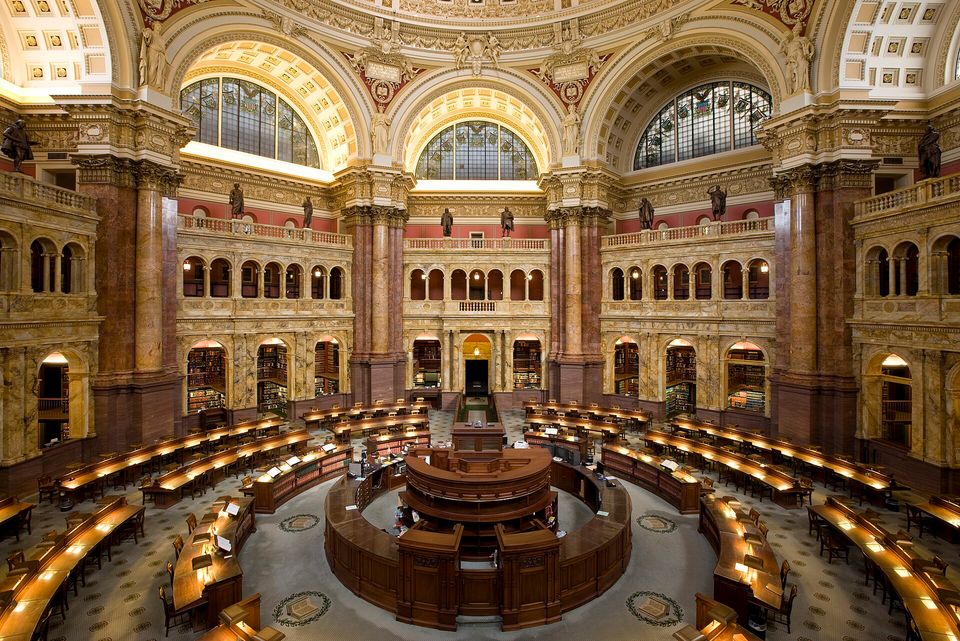
It was the first building the library had to itself, and its Main Reading Room, in the photograph, is still where readers call for books from a collection the library describes as the largest in the world.
Why did the library need a building?
Congress created its library in 1800 by an act that set aside five thousand dollars for books, and housed it in the Capitol. British troops burned the Capitol in August 1814 and the library with it; Thomas Jefferson offered his own library as a replacement, and in 1815 Congress bought his 6,487 volumes for $23,950, the purchase that gave the collection its breadth and the building its name. The library grew fast after the Copyright Act of 1870 made it the deposit library for every work registered in the United States, and by the 1880s the Librarian, Ainsworth Rand Spofford, was reporting to Congress that books were piled on the floors. An act of 1886 authorised a separate building on the square east of the Capitol.
The architects
The design came from a competition of 1873 won by the Washington architects John L. Smithmeyer and Paul J. Pelz, whose Italian Renaissance scheme was revised for years before construction began in 1889. They were dismissed in 1892 and the building was finished by the army engineer Bernard R. Green, who had managed the works, and the architect Edward Pearce Casey, who directed the interior decoration. The library's account records that the building came in under the appropriation, at a little over six million dollars against six and a half authorised, and that more than forty American painters and sculptors worked on its halls, so that the building was described at its opening as a national monument to art as much as a library.
The reading room
The Main Reading Room is an octagon under a dome whose lantern rises 160 feet above the floor, according to the library's description, with the reading desks in concentric circles around a central desk from which books once arrived by pneumatic tube and conveyor from the stacks. Eight giant columns carry statues representing fields of knowledge, and sixteen bronze figures on the balustrade above represent their practitioners, from Moses to Beethoven. The room is open to anyone over sixteen with a reader's card, and the library's Gutenberg Bible and Giant Bible of Mainz are shown in the Great Hall below.
The building today
The library outgrew the building within a generation: the John Adams Building opened behind it in 1939 and the James Madison Memorial Building across Independence Avenue in 1980, when the original was renamed for Jefferson. A restoration from 1984 to 1997 returned the Great Hall's paintings and gilding for the building's centenary, and since 2016 the library has been rebuilding the Great Hall's visitor route and its exhibition galleries, which now show the Jefferson library reconstructed on its original shelves.
Frequently asked questions
When did the Jefferson Building open?
The Thomas Jefferson Building opened to the public on 1 November 1897. It was the first building the Library of Congress had to itself; since 1800 the library had been housed in the Capitol.
Why is it named after Thomas Jefferson?
After British troops burned the Capitol and its library in August 1814, Jefferson offered his own library as a replacement, and in 1815 Congress bought his 6,487 volumes for $23,950. The building was renamed for him in 1980.
Who designed the Jefferson Building?
The Washington architects John L. Smithmeyer and Paul J. Pelz, who won a competition in 1873. They were dismissed in 1892, and the building was finished by the army engineer Bernard R. Green and the architect Edward Pearce Casey, who directed the interior decoration.