
How a fresco is painted: wet plaster, a day's work at a time and the chemistry of lime
Why the painter cannot stop for lunch, and how restorers can count the days on the Sistine ceiling
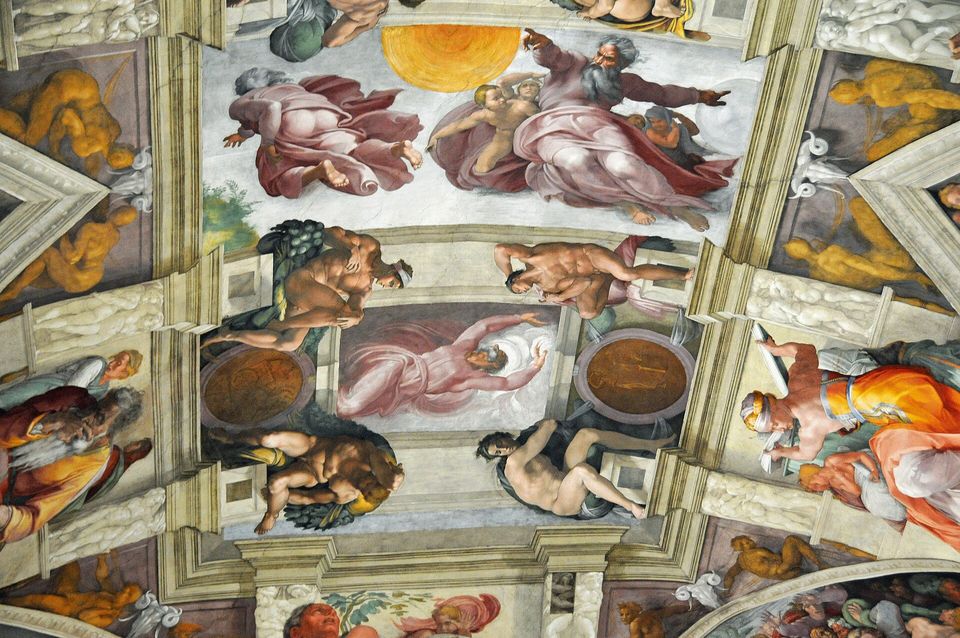
A true fresco is painted into wet lime plaster, which locks the colour in as it dries. This explains the layers, the day's patch called a giornata, the reaction that fixes the pigment, and what the fifteenth-century handbook and the Sistine Chapel tell us about how it was done.
Key points
- In buon fresco, pigment mixed only with water is applied to freshly laid lime plaster, which binds the colour as it sets.
- As the plaster dries, calcium hydroxide reacts with carbon dioxide in the air and turns back into calcium carbonate.
- The patch of intonaco laid for one session is a giornata, a day's work; the seams between giornate remain visible to restorers.
- Michelangelo painted the Sistine ceiling between 1508 and 1512; the Vatican's restoration of 1980 to 1994 mapped its giornate.
A fresco is a wall painting made by applying pigment mixed only with water to a layer of freshly laid lime plaster, so that the colour is bound not by a glue or an oil but by the plaster itself as it sets.
The word is the Italian for fresh, and the technique proper is buon fresco; painting on plaster that has already dried, with the pigment bound by egg, glue or lime water, is fresco secco and does not last as well, which is why so many medieval wall paintings survive as ghosts. The method is described in detail in Il libro dell'arte, a handbook written by the Florentine painter Cennino Cennini around 1400.
The chemistry
Lime plaster is made from limestone burned to quicklime, slaked with water to calcium hydroxide, and mixed with sand. As the wet plaster dries, the calcium hydroxide reacts with carbon dioxide in the air and turns back into calcium carbonate, the substance of the original stone. Pigment laid on the surface while this is happening is caught in the crystals as they form, so the finished fresco is a thin layer of coloured stone rather than a coat of paint. The window for painting is the hours during which the surface is damp: once it has set, colour added on top will only sit on the surface. Pigments must survive the alkali, so lime-safe earths, ochres and minerals are used and some blues and greens have to be added secco afterwards.
The layers
Cennini describes the wall being prepared with a rough coat, the arriccio, on which the painter drew the composition in red earth; that underdrawing is called a sinopia, after the port that supplied the pigment, and sinopie have been recovered from under detached frescoes and are exhibited in their own right. Over the arriccio the plasterer laid the smooth final coat, the intonaco, but only over the area the painter could finish that day. Later painters replaced the sinopia with full-size drawings on paper, the cartoons, whose outlines were transferred to the wet intonaco by pouncing charcoal through pricked holes or by pressing the lines through with a stylus; both marks can be seen on the plaster under raking light.
The day's work
The patch of intonaco laid for one session is a giornata, a day's work. At the end of the day the unpainted plaster is cut away along an edge that follows a contour in the design, a fold of drapery or the line of a hill, and the next day's plaster is laid against it. The seams remain, and a restorer working close to the surface can map them and count the days. The Vatican Museums' restoration of Michelangelo's ceiling in the Sistine Chapel, carried out between 1980 and 1994, mapped the giornate across the vault, which was painted between 1508 and 1512 for Pope Julius II and unveiled on 1 November 1512; the mapping showed large figures done in a single day and faces that took a day on their own.
Why does a fresco last, and why does it fail?
A buon fresco on a dry, stable wall can last for centuries, because there is no binder to yellow or flake. Its enemies are water and salts rising through the wall, which push the plaster off, and the soot of candles and lamps, which is what the Sistine restorers removed with sponges of distilled water and a mild solvent to recover the colour underneath.
Frequently asked questions
What is the difference between buon fresco and fresco secco?
Buon fresco is painted into wet lime plaster, so the colour is bound by the plaster itself as it sets. Fresco secco is painted on plaster that has already dried, with the pigment bound by egg, glue or lime water, and it does not last as well.
What is a giornata?
A giornata, a day's work, is the patch of smooth final plaster laid for one painting session. At the end of the day the unpainted plaster is cut away along a contour in the design and the next day's plaster is laid against it, leaving a seam.
Why do frescoes last so long?
A buon fresco on a dry, stable wall has no binder to yellow or flake: the pigment is caught in crystals of calcium carbonate as the plaster sets. Its enemies are water and salts rising through the wall, and the soot of candles and lamps.