
How an orchestra is seated, and why the cellos sit where they do
Strings in front, winds in the middle, brass and percussion at the back: the logic of the plan
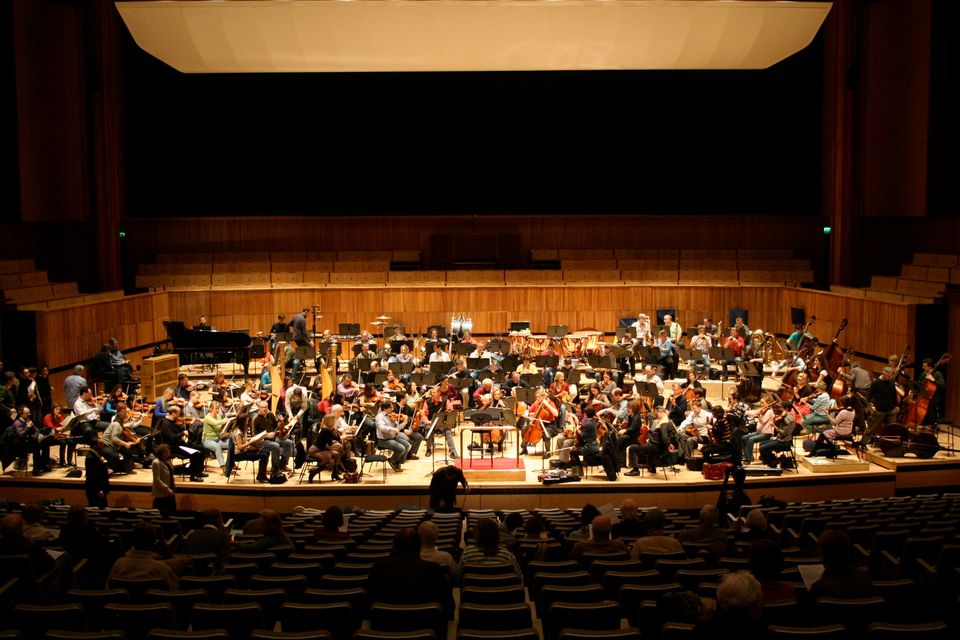
A symphony orchestra's seating is not a tradition kept for its own sake but a solution to problems of balance, sightline and sound. This is the plan most orchestras use, the older plan some have returned to, and what each choice does to what the hall hears.
Key points
- A symphony orchestra is arranged in a fan around the conductor, with strings in front, woodwind in the middle and brass and percussion behind.
- In the plan most orchestras use today the first violins sit at the conductor's left and the cellos at the right, with the double basses behind them.
- Norman Del Mar gives a large orchestra's strings as sixteen first violins, fourteen seconds, twelve violas, ten cellos and eight basses.
- The oboe gives the tuning A; ISO 16, first published in 1975, sets that A at 440 hertz.
A symphony orchestra on a concert platform is arranged in a fan around the conductor: the strings in front, the woodwind in the middle, the brass and percussion behind, and the harp, piano or celesta wherever the stage allows.
The plan exists because the sections are not equally loud. A trumpet can carry over sixty string players, and a solo oboe cannot, so the quiet instruments are put closest to the audience and the loud ones furthest away.
The strings
The string section is the largest and is set out in five groups. In the plan most orchestras use today, the first violins sit at the conductor's left, the second violins beside them, the violas in the centre right, the cellos at the conductor's right and the double basses behind the cellos. The leader, called the concertmaster in American usage, sits on the outside of the first desk of first violins, where the conductor can see him and the audience can see the bowing that the rest of the section copies. Norman Del Mar's standard reference, Anatomy of the Orchestra, gives the full complement of a large symphony orchestra's strings as sixteen first violins, fourteen seconds, twelve violas, ten cellos and eight basses, though the numbers shrink for Haydn and grow for Mahler.
The other plan
This arrangement, with all the violins on the left, is often called American seating and is associated with Leopold Stokowski, who adopted it in Philadelphia in the 1920s; its advantage is that the violins' f-holes all face the hall. The older European plan places the second violins on the conductor's right, opposite the firsts, with the cellos and basses on the left. Composers from Mozart to Mahler wrote with that antiphonal layout in mind, and passages in which the two violin sections answer each other only sound as written when they sit apart. A number of orchestras and conductors have returned to the older plan for this reason, and a listener can often tell which plan is in use from the first bars.
Winds, brass and percussion
The woodwind sit in two rows in the centre, flutes and oboes in front, clarinets and bassoons behind, each principal in the middle of the block so the four can hear one another. The oboe gives the tuning note, an A, because its sound is penetrating and its pitch is the least easily adjusted; the standard pitch for that A, 440 hertz, is set by the international standard ISO 16, first published in 1975, though many orchestras choose to tune a little above it. The horns sit to one side of the winds, the trumpets, trombones and tuba behind them, and the timpani and percussion along the back wall, where their sound has the whole hall to spread into before it reaches the front rows.
What does the hall change?
Seating is adjusted to the room. On a shallow stage the basses may be moved to the back wall so their sound reflects forward; in a hall with the audience on all sides, as at the Berlin Philharmonie, the plan is the same but the sound reaches every listener differently. The conductor decides, the orchestra's stage manager draws the plan, and a programme that pairs a Mozart symphony with a Strauss tone poem will have the stage reset in the interval.
Frequently asked questions
Why do the strings sit at the front of an orchestra?
Because the sections are not equally loud. A trumpet can carry over sixty string players and a solo oboe cannot, so the quiet instruments are placed closest to the audience and the loud brass and percussion furthest away.
What is the difference between American and European seating?
In American seating, associated with Leopold Stokowski in Philadelphia in the 1920s, all the violins sit on the conductor's left. The older European plan puts the second violins on the right, opposite the firsts, with cellos and basses on the left, so the two violin sections can answer each other.
Why does the oboe give the tuning note?
The oboe gives the A because its sound is penetrating and its pitch is the least easily adjusted. The standard pitch for that A, 440 hertz, is set by ISO 16, first published in 1975, though many orchestras tune a little above it.