
How the Louvre became a museum, from a fortress on the Seine to the glass pyramid
A twelfth-century keep, a royal palace, a Revolutionary decree and a 1989 entrance under a courtyard
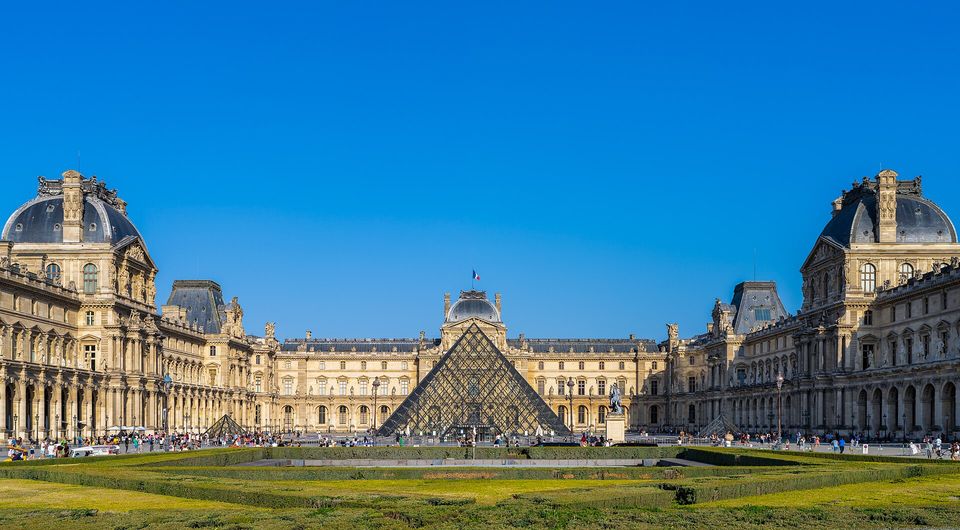
The world's most visited museum began as a castle built to guard Paris and became a public gallery by a vote of the National Convention in 1793. This is how the building and the collection grew, in the order the records give.
Key points
- About 1190 Philippe Auguste ordered a castle with a great round keep at the western edge of Paris, the first Louvre.
- From 1546 Francis I began the Renaissance palace, pulling down the keep and commissioning Pierre Lescot's wing.
- The Muséum central des arts opened in the Grande Galerie of the Louvre on 10 August 1793.
- I. M. Pei's glass pyramid, 21.6 metres high, was inaugurated in March 1989; the Richelieu wing opened in 1993.
The Musée du Louvre occupies a palace on the right bank of the Seine that was built and rebuilt over eight hundred years before it was a museum.
The museum's own history begins with a fortress: about 1190 Philippe Auguste, leaving on crusade, ordered a wall around Paris and a castle with a great round keep at the western edge of the city, where the river road came in. The lower parts of that keep and its moat were uncovered in the 1980s and can be walked around under the Cour Carrée today.
The palace
Charles V turned the fortress into a residence in the fourteenth century, and from 1546 Francis I began the Renaissance palace, pulling down the keep and commissioning Pierre Lescot's wing on the west side of the present Cour Carrée. Francis was also the first collector of the royal pictures, and the Mona Lisa, which Leonardo had brought to France, entered the royal collection under him. Later kings extended the palace along the river towards the Tuileries, the garden palace Catherine de' Medici had begun; after Louis XIV moved the court to Versailles in 1682, the Louvre was left to academies, artists and lodgers.
When did the Louvre open as a museum?
The idea of showing the royal collection to the public was discussed under Louis XVI, and the Revolution carried it out. The National Convention decreed on 27 July 1793 that a Muséum central des arts would open in the Grande Galerie, and it did so on 10 August 1793, the first anniversary of the fall of the monarchy, with the paintings of the former crown, the confiscated collections of émigrés and the Church, and, under Napoleon, the works seized in the wars, most of which were returned after 1815. The museum was open to artists on some days and to the public on others, and entry was free, a principle that lasted until 1922.
The Grand Louvre
For most of the twentieth century the Ministry of Finance occupied the north wing along the rue de Rivoli. In 1981 President François Mitterrand decided to give the whole palace to the museum, and the architect I. M. Pei designed a new entrance in the middle of the Cour Napoléon, a glass pyramid 21.6 metres high over an underground hall from which the three wings, Denon, Sully and Richelieu, are reached. The pyramid was inaugurated in March 1989 and the Richelieu wing, vacated by the ministry, opened in 1993. The museum's collections are organised in eight departments, from Egyptian and Near Eastern antiquities to paintings, sculpture and decorative arts, and its annual report gives attendance in 2024 as 8.7 million visitors.
The branches
The Louvre has lent its name and its works to two buildings elsewhere: the Louvre-Lens, opened in 2012 in the former mining town in the Pas-de-Calais, and the Louvre Abu Dhabi, opened in 2017 under a thirty-year intergovernmental agreement signed in 2007, which the museum's pages describe as the first universal museum in the Arab world.
Frequently asked questions
When did the Louvre become a museum?
The National Convention decreed on 27 July 1793 that a Muséum central des arts would open in the Grande Galerie, and it opened on 10 August 1793, the first anniversary of the fall of the monarchy.
What was the Louvre before it was a museum?
First a fortress: about 1190 Philippe Auguste ordered a castle with a great round keep to guard the western edge of Paris. Charles V made it a residence in the fourteenth century, and from 1546 Francis I began the Renaissance palace.
When was the Louvre pyramid built?
President François Mitterrand decided in 1981 to give the whole palace to the museum, and the architect I. M. Pei designed a glass pyramid 21.6 metres high as its new entrance in the Cour Napoléon. It was inaugurated in March 1989.