
Shakespeare's Globe: how an Elizabethan timber theatre was rebuilt on Bankside
Green oak, lime plaster, a thatched roof and an audience of seven hundred standing in the rain
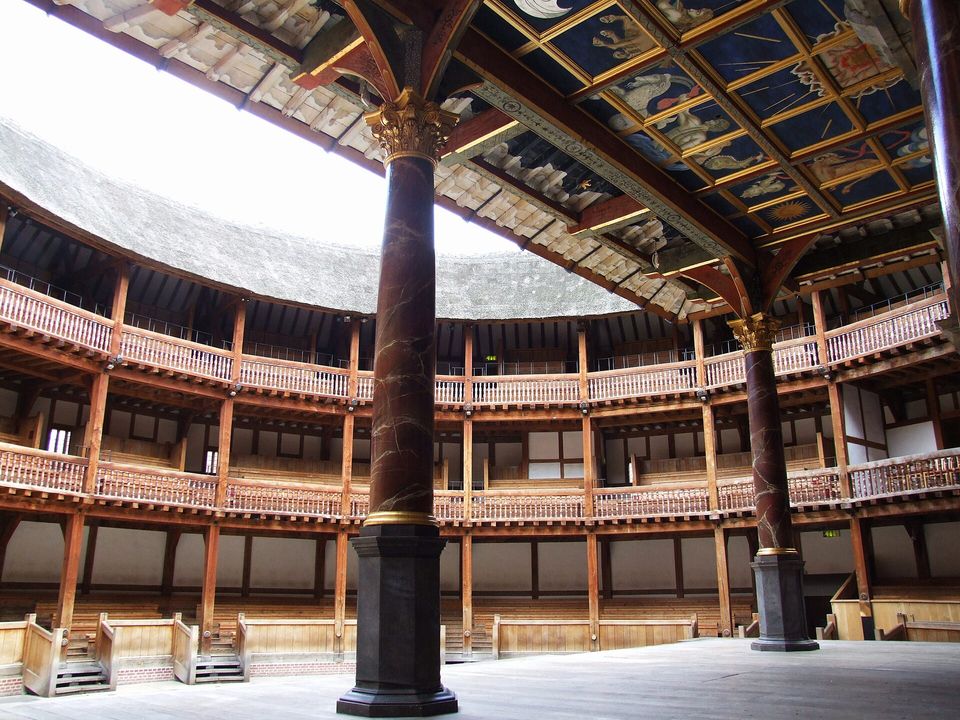
The Globe that opened in London in 1997 is a reconstruction of the theatre Shakespeare's company built in 1599 a few hundred metres away. This is what is known about the original, how the new one was designed from the evidence, and what it is like to stand in the yard.
Key points
- Shakespeare's Globe opened in 1997 on Bankside, about 230 metres from the site of the playhouse of 1599.
- The first Globe burned down on 29 June 1613, when a cannon fired during Henry VIII set the thatch alight.
- The 1989 excavation showed that the original was a twenty-sided building about 30 metres across.
- The theatre puts its capacity at about 1,570, of whom up to 700 stand in the yard.
Shakespeare's Globe is a theatre on the south bank of the Thames at Bankside, opened in 1997 as a reconstruction of the playhouse in which Shakespeare's company, the Lord Chamberlain's Men and later the King's Men, performed from 1599.
It stands about 230 metres from the site of the original, whose foundations lie under a listed Georgian terrace and a road and were partly uncovered by archaeologists in 1989. The project was the work of the American actor and director Sam Wanamaker, who campaigned for it from 1970 and died in 1993, four years before it opened.
What was the original Globe like?
The first Globe was built in 1599 from the timbers of an earlier playhouse, the Theatre in Shoreditch, which the company's carpenter Peter Street dismantled after a dispute with the landlord and carried across the river. It was a polygon of timber frame, open to the sky in the middle, with three tiers of galleries and a stage thrust into a yard where the cheapest spectators stood. On 29 June 1613 it burned to the ground when a cannon fired during a performance of Henry VIII set the thatch alight; it was rebuilt within a year with a tiled roof, closed with all London theatres by Parliament in 1642, and demolished about 1644. No plan of it survives, and the evidence for its shape is a handful of drawings of other playhouses, the building contract for the rival Fortune theatre of 1600, which refers to the Globe as its model, and the 1989 excavation, which showed a twenty-sided building about 30 metres across.
The reconstruction
The architect Theo Crosby and the building historians advising the project designed a twenty-sided polygon of English green oak, jointed with oak pegs rather than bolts, on the pattern the excavation and the Fortune contract suggested; the walls are lime plaster on oak laths, and the galleries' roof is water reed thatch, the first thatched roof permitted in London since the Great Fire of 1666, laid over a fire-resistant membrane with sprinklers along the ridge. The stage is covered by a painted canopy on two pillars and backed by a wall with two doors and a central opening, above which is a balcony. The theatre's own account puts the capacity at about 1,570, of whom up to 700 stand in the yard as the original audience did, and performances are given in daylight or under lights that imitate it, with no amplification.
How it is used
The Globe is a working theatre with a summer season of Shakespeare and new plays, a research department that tests staging practice, and, since 2014, an indoor candle-lit theatre beside it, the Sam Wanamaker Playhouse, built to a design found among seventeenth-century drawings for a covered playhouse. The company receives no regular state subsidy and runs on tickets, education and visitors.
Frequently asked questions
Is Shakespeare's Globe the original theatre?
No. It is a reconstruction opened in 1997, about 230 metres from the site of the original, which was built in 1599, burned in 1613, was rebuilt within a year, and was demolished about 1644.
How do we know what the first Globe looked like?
No plan survives. The evidence is a handful of drawings of other playhouses, the building contract for the Fortune theatre of 1600, which refers to the Globe as its model, and the 1989 excavation, which showed a twenty-sided building about 30 metres across.
Who rebuilt the Globe?
The project was the work of the American actor and director Sam Wanamaker, who campaigned for it from 1970 and died in 1993, four years before it opened. The architect was Theo Crosby, working with building historians.