
The Cinématographe: how the Lumière brothers made a camera that also printed and projected
A patent in February 1895, a factory gate in March and a Paris café in December
The machine that gave cinema its name was built in Lyon by two makers of photographic plates and shown to a paying public on 28 December 1895. This is what the Cinématographe was, how it differed from Edison's Kinetoscope and what the Institut Lumière keeps of it.
Key points
- Auguste and Louis Lumière of Lyon patented the Cinématographe on 13 February 1895; the engineer Jules Carpentier built it.
- The Cinématographe could photograph a strip of film, print a positive from it and project the result on a wall.
- It ran at about sixteen frames a second, and a reel of about seventeen metres lasted under a minute.
- The first screening to a paying public was on 28 December 1895 in the Salon Indien of the Grand Café in Paris; the ticket cost one franc.
The Cinématographe was a hand-cranked machine, small enough to carry in a case, that could photograph a strip of film, print a positive from it and project the result on a wall. It was patented by Auguste and Louis Lumière of Lyon on 13 February 1895 and built by the engineer Jules Carpentier.
The brothers' family firm made photographic plates at Montplaisir, in the south of the city, and the film they shot in March 1895 of their workers leaving that factory, La Sortie de l'usine Lumière à Lyon, is treated as the first film of the cinema.
What it did
The Cinématographe used 35 mm film with one round perforation on each side of every frame, moved through the gate by a claw mechanism that the Lumières adapted from the feed of a sewing machine: the claw pulled the film down one frame, held it still while the shutter opened, and pulled again. It ran at about sixteen frames a second, which is why early films look hurried when shown at today's twenty-four. A reel held about seventeen metres and lasted under a minute. The same box, fitted with a lantern behind it, projected the print, and with a second strip of blank film it could make that print by contact. The Institut Lumière gives its weight as about five kilograms.
Why did it matter?
Thomas Edison's laboratory had been recording moving pictures since 1891 and selling the Kinetoscope since 1894, but that was a cabinet through which one viewer at a time watched a loop through an eyepiece; there was no projection. The Lumières' machine put the picture on a screen in front of a room, which made a film a public event with a ticket price, and in time with festivals and juries. It was also light and needed no electricity, so the operators the company trained could carry it anywhere, and by 1896 Lumière operators were filming and projecting in London, New York, Bombay, Cairo and Buenos Aires.
The first screenings
The first showing was private, to the Société d'encouragement pour l'industrie nationale in Paris on 22 March 1895. The first screening to a paying public was on 28 December 1895 in the Salon Indien, a basement room of the Grand Café at 14 boulevard des Capucines, with a programme of ten short films including the factory gate, a baby's breakfast and a gardener sprayed by his own hose; the ticket cost one franc. The Institut Lumière's catalogue of the company's films counts about 1,400 titles made by 1905, after which the brothers left film to concentrate on colour photography, whose Autochrome plate they patented in 1903.
What survives
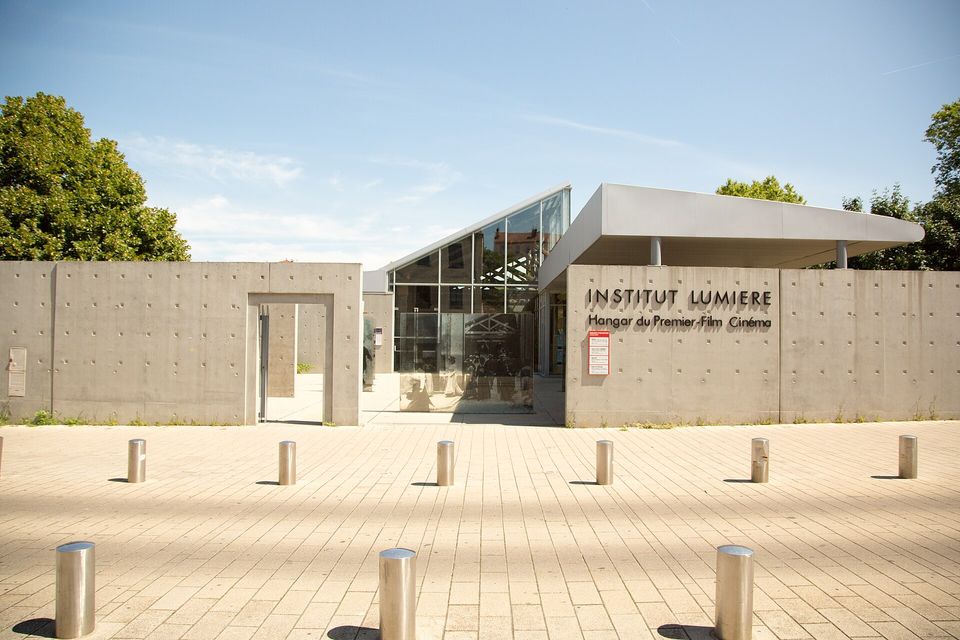
The Institut Lumière, founded in 1982 in the family's villa at Montplaisir, keeps the brothers' cameras, plates and papers and runs a cinema in the Hangar du Premier-Film, the surviving shed of the factory whose gate appears in the first film. The original patent and the Lumière negatives are held with the French state's collections, and the restored films are published by the Institut in its Lumière catalogue.
Frequently asked questions
What was the Cinématographe?
A hand-cranked machine, small enough to carry in a case, that could photograph a strip of 35 mm film, print a positive from it and project the result. Auguste and Louis Lumière of Lyon patented it on 13 February 1895.
When was the first public film screening?
The first screening to a paying public was on 28 December 1895 in the Salon Indien, a basement room of the Grand Café at 14 boulevard des Capucines in Paris. The programme was ten short films and the ticket cost one franc.
How did the Cinématographe differ from Edison's Kinetoscope?
The Kinetoscope, sold from 1894, was a cabinet through which one viewer at a time watched a loop through an eyepiece. The Lumières' machine projected the picture on a screen in front of a room, and it was light and needed no electricity.