
Brasília in a page: a capital built in 41 months on a plateau, listed by UNESCO before it was thirty
Capitals in a page, part three: founding, government, people, landmarks and transport in documented facts
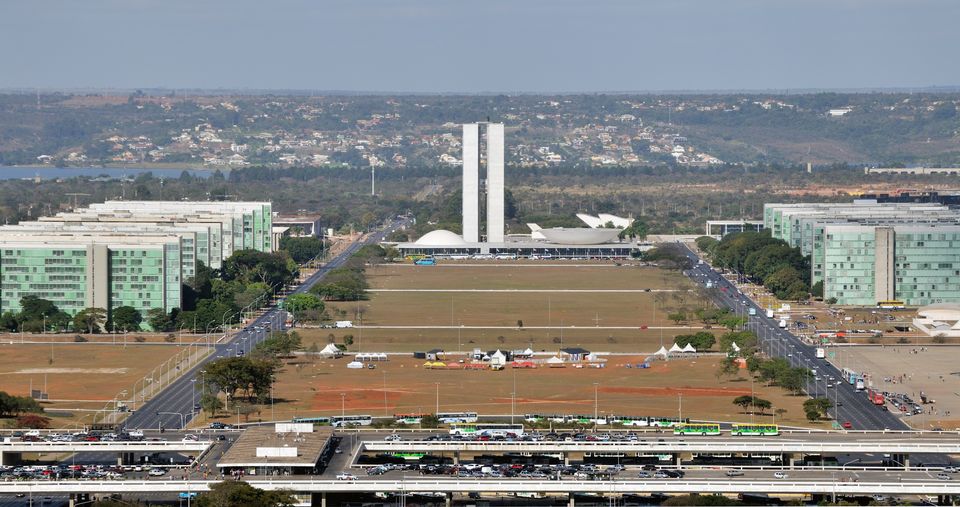
Brazil's constitution had promised an inland capital since 1891. Juscelino Kubitschek built it between 1956 and 1960 to a plan by Lúcio Costa and buildings by Oscar Niemeyer, and UNESCO listed the result before it was thirty years old.
Key points
- The 2022 Census counted 2,817,381 people in Brazil's Federal District; most live in satellite towns rather than the planned Plano Piloto.
- Lúcio Costa won the competition for Brasília's plan in 1957; Oscar Niemeyer designed the principal buildings and Roberto Burle Marx the landscape.
- Brasília was inaugurated on 21 April 1960, forty-one months after the first workers arrived.
- UNESCO inscribed Brasília on the World Heritage List in 1987, the first twentieth-century urban ensemble to be listed.
- Under Brazil's 1988 Constitution the Federal District cannot be divided into municipalities and is governed by a Governor and a 24-member Legislative Chamber.
Brasília was built in forty-one months: President Juscelino Kubitschek ordered construction in 1956, Lúcio Costa won the competition for its plan in 1957, and the city was inaugurated on 21 April 1960 with buildings by Oscar Niemeyer. UNESCO inscribed it on the World Heritage List in 1987, when it was twenty-seven years old.
Brasília is the capital of Brazil and the seat of its three federal powers, on the central plateau at about 1,100 metres, some 1,000 kilometres from the old capital, Rio de Janeiro. It lies within the Federal District, which the 2022 Census of the Brazilian Institute of Geography and Statistics counted at 2,817,381 people, the third most populous municipality-level unit in the country. The planned city that appears in photographs, the Plano Piloto, holds a minority of them; most residents live in the satellite towns that grew around it.
How was Brasília planned and built?
The idea is older than the republic: the constitution of 1891 set aside land on the plateau for a future capital, and a commission fixed the site in 1955. President Juscelino Kubitschek, elected on a promise of "fifty years of progress in five", ordered construction in 1956. A competition for the plan was won in 1957 by Lúcio Costa, whose Plano Piloto is shaped like a bird or an aeroplane: a curved residential axis crossed by the straight Monumental Axis, which runs from the railway station past the ministries to the Square of the Three Powers. Oscar Niemeyer designed the principal buildings and Roberto Burle Marx the landscape. The city was inaugurated on 21 April 1960, forty-one months after the first workers arrived. UNESCO inscribed it on the World Heritage List in 1987, the first twentieth-century urban ensemble to be listed.
Government
Under the constitution of 1988 the Federal District cannot be divided into municipalities; it is governed as a whole by an elected Governor and a Legislative Chamber of 24 deputies, and subdivided for administration into regions run by appointed administrators. The federal presence is on the Monumental Axis: the National Congress, with its twin 28-storey towers and two domes, the Senate's bowl turned down and the Chamber of Deputies' turned up, the Planalto Palace of the presidency and the Supreme Federal Court, all on the Square of the Three Powers.
People
The district's economy is dominated by public administration, which IBGE reports as the largest component of its output, and it has the highest per-capita income of any Brazilian state or district in the institute's regional accounts. The University of Brasília, founded in 1962 to a plan by Darcy Ribeiro and Anísio Teixeira, stands beside the lake.
Landmarks
Niemeyer's Cathedral, a crown of sixteen concrete columns with glass between them, was dedicated in 1970. The Alvorada Palace, the president's residence, was finished in 1958 before the city itself. The Itamaraty Palace houses the foreign ministry; the television tower on the Monumental Axis rises 224 metres; the JK Bridge across Lake Paranoá, an artificial lake completed in 1959, opened in 2002. The Memorial JK holds Kubitschek's tomb.
Transport
Brasília was designed for the car, with superblocks and cloverleaf junctions and few pedestrian crossings on the axes. The Metrô-DF, a two-line, 42-kilometre metro serving the satellite towns to the south-west, opened in 2001. Presidente Juscelino Kubitschek International Airport, one of the country's busiest, handles connections between the north and the south of Brazil.
Frequently asked questions
Why did Brazil build Brasília?
The idea is older than the republic, and the constitution of 1891 set aside land on the central plateau for a future capital; a commission fixed the site in 1955. President Juscelino Kubitschek, elected on a promise of "fifty years of progress in five", ordered construction in 1956.
Who designed Brasília?
Lúcio Costa drew the Plano Piloto, which won the 1957 competition and is shaped like a bird or an aeroplane. Oscar Niemeyer designed the principal buildings, among them the National Congress and the Cathedral, and Roberto Burle Marx the landscape.
How is Brasília governed?
Brasília lies in the Federal District, which the 1988 Constitution forbids from being divided into municipalities. The district is governed as a whole by an elected Governor and a Legislative Chamber of 24 deputies, and subdivided for administration into regions run by appointed administrators.