
What the Strategic Petroleum Reserve is: crude oil in salt caverns, and who may release it
Four sites on the Gulf Coast, an Act of 1975, and the largest drawdown in its history in 2022
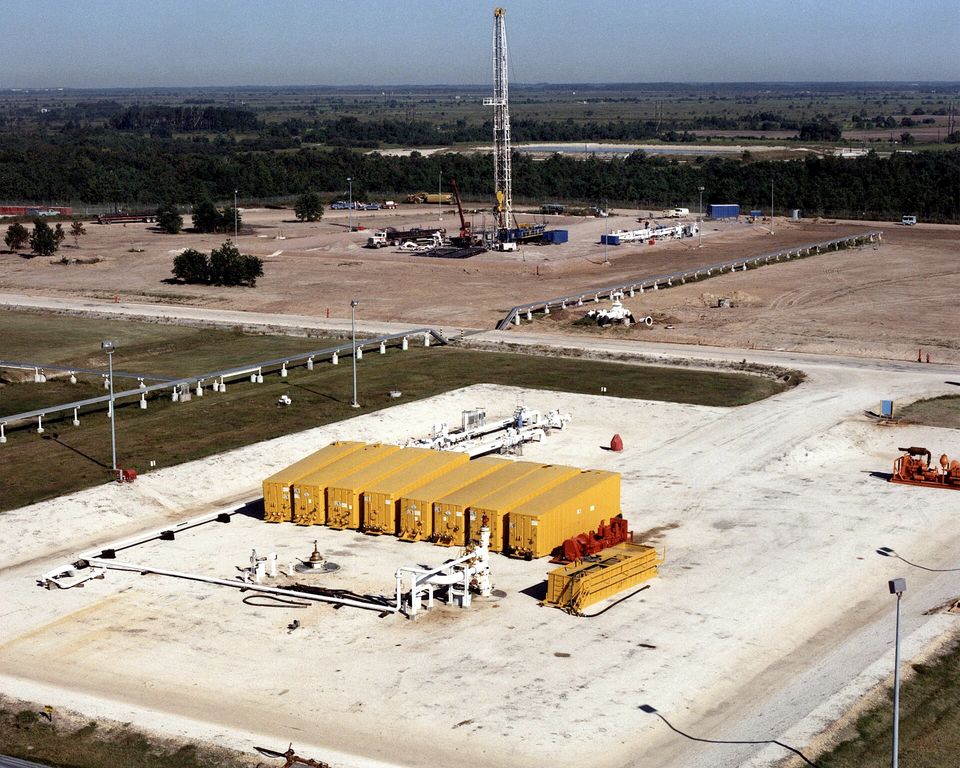
The United States keeps hundreds of millions of barrels of crude oil in salt caverns under Texas and Louisiana. The reserve was created after the 1973 embargo, is governed by a 1975 statute, and was drawn down harder in 2022 than ever before. How it works and what it is for.
Key points
- The reserve holds crude in salt caverns at Bryan Mound and Big Hill in Texas and West Hackberry and Bayou Choctaw in Louisiana.
- The reserve was created by the Energy Policy and Conservation Act of 1975 and received its first oil in 1977.
- The Department of Energy gives the reserve's authorised capacity as 714 million barrels, the largest emergency stockpile in the world.
- In March 2022 the Administration announced a release of one million barrels a day for six months, about 180 million barrels.
- IEA members must hold oil stocks equal to 90 days of net imports under the International Energy Program agreed in 1974.
The Strategic Petroleum Reserve is the emergency crude oil stockpile of the United States government, held in underground salt caverns at four sites along the Gulf of Mexico coast: Bryan Mound and Big Hill in Texas, West Hackberry and Bayou Choctaw in Louisiana. The reserve is managed by the Department of Energy's Office of Petroleum Reserves.
It was created by the Energy Policy and Conservation Act of 1975, passed after the Arab oil embargo of 1973 and 1974, and received its first oil in 1977. The Department's own pages give its authorised capacity as 714 million barrels, which makes it the largest emergency stockpile in the world.
Why salt
The oil is stored in caverns dissolved out of salt domes by pumping in fresh water and pumping out brine. Salt is impermeable and self-sealing, and the caverns, which the Department describes as typically some 600 metres below the surface, hold oil at a small fraction of the cost of surface tanks. To withdraw oil, water is pumped into the bottom of the cavern and the lighter oil floats out at the top. Each site is connected by pipeline to commercial terminals and refineries, and the reserve can deliver into the market at a maximum published rate of about 4.4 million barrels a day.
Who can release the oil?
The Act allows the President to order a drawdown in the event of a severe energy supply interruption, or to meet US obligations under the International Energy Program, the 1974 agreement that founded the International Energy Agency and requires members to hold stocks equal to 90 days of net imports. Congress has also directed sales for budgetary reasons, and the Department conducts exchanges, lending oil to refiners after hurricanes and receiving it back with a premium. The largest emergency use came in 2022: the Administration announced in March a release of one million barrels a day for six months, about 180 million barrels, in response to the disruption following Russia's invasion of Ukraine, and the reserve fell to its lowest level since the early 1980s before the Department began buying oil back.
What the reserve is not
The reserve holds crude oil, not petrol or diesel; refining capacity is a separate question. It is also not a price-management tool by statute, though presidents of both parties have used releases at moments of high prices. The Government Accountability Office has reported on the ageing of the caverns and pipelines and on the cost of maintaining a reserve sized for an era when the United States imported far more crude than it does now.
Elsewhere
Every IEA member holds emergency stocks, and the Agency coordinates collective releases: it did so in 1991, 2005, 2011 and twice in 2022. Japan, South Korea and the European members hold theirs in a mix of government and industry stocks. China has built a strategic reserve since 2004 but does not publish its level; the IEA's monthly Oil Market Report notes the gap in its accounting.
Frequently asked questions
Who can order a release from the Strategic Petroleum Reserve?
The President, under the Energy Policy and Conservation Act, in a severe energy supply interruption or to meet US obligations under the International Energy Program. Congress has also directed sales for budgetary reasons, and the Department of Energy lends oil to refiners in exchanges after hurricanes.
Why is the oil stored in salt caverns?
Salt is impermeable and self-sealing, and caverns dissolved out of salt domes hold oil at a small fraction of the cost of surface tanks. To withdraw it, water is pumped into the bottom of a cavern and the lighter oil floats out at the top.
How much oil was released in 2022?
In March 2022 the Administration announced a release of one million barrels a day for six months, about 180 million barrels, after Russia's invasion of Ukraine. The reserve fell to its lowest level since the early 1980s before the Department began buying oil back.
Sources
- Strategic Petroleum Reserve
- SPR Quick Facts
- SPR Storage Sites
- 42 U.S.C. 6231, Energy Policy and Conservation Act: congressional finding and declaration of policy
- Fact sheet: President Biden's plan to respond to Putin's price hike at the pump (31 March 2022)
- Oil security and emergency response
- History of the IEA