
Video: unfolding the James Webb sunshield in a clean room, the rehearsal for the real thing
NASA Goddard's time-lapse of the ground test, and why the five layers had to be opened on Earth first
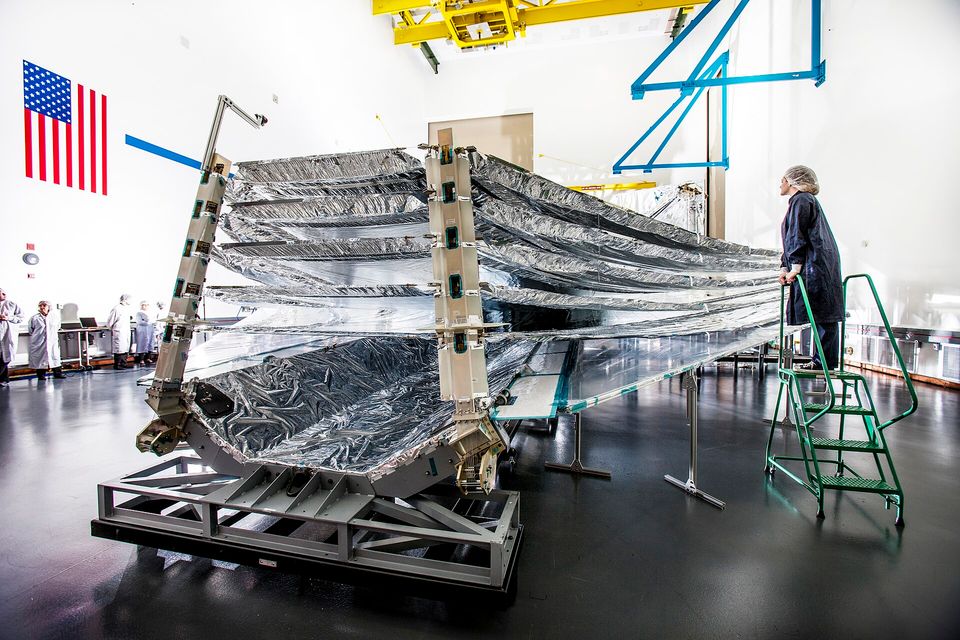
Before Webb's sunshield could be opened in space it was opened on the floor of a clean room in California, with the layers hanging from rigs that took the place of zero gravity. The time-lapse shows the folded stack becoming a five-layer kite the size of a tennis court.
Key points
- The ground deployment test took place at the Northrop Grumman plant in Redondo Beach, California, where Webb was assembled.
- Webb's five-layer sunshield unfolds to about 21 by 14 metres and keeps the telescope and instruments in shade at about 40 kelvin.
- The sunshield's 107 release devices, cables and motors could not be tested in flight, so every mechanism was exercised on the ground in 2018 and 2019.
- In space the sunshield deployed between 28 December 2021 and 4 January 2022, following the rehearsed sequence step by step.
The clip is a time-lapse released by NASA's Goddard Space Flight Center of a ground deployment test of the James Webb Space Telescope's sunshield, carried out at the Northrop Grumman plant in Redondo Beach, California, where the observatory was assembled.
It compresses hours of slow, monitored motion into about a minute: the five folded membranes are released from their stowed position, the two booms extend to pull them out sideways, and the layers are tensioned one by one into their final separated shape.
Why was the sunshield unfolded on Earth first?
The sunshield is the part of Webb that makes its infrared observations possible, by keeping the telescope and instruments in permanent shade at about 40 kelvin. Its five layers of aluminium-coated Kapton, each thinner than a hair, unfold to about 21 by 14 metres, according to NASA's specifications, and the sequence of 107 release devices, cables and motors that opens them could not be tested in flight before it was needed. Every mechanism was therefore exercised on the ground, in a sequence of tests through 2018 and 2019, with the membranes supported by rigs that offloaded their weight to mimic the absence of gravity, and with engineers checking each layer for snags and tears afterwards. The photograph on this page is from an earlier full-scale test of the design.
How it went in space
The real deployment took place between 28 December 2021 and 4 January 2022, a week after launch, and followed the rehearsed sequence step by step; NASA's mission blog reported the final tensioning of the fifth layer on 4 January. It was the step the project had identified beforehand as its greatest single risk, because of the number of moving parts and the impossibility of repair at the telescope's station 1.5 million kilometres from Earth.
The clip was produced by NASA and is in the public domain as the work of a US federal agency; it was uploaded to Wikimedia Commons under that status.
Frequently asked questions
Why was Webb's sunshield unfolded on Earth before launch?
Its sequence of 107 release devices, cables and motors could not be tested in flight before it was needed, and nothing could be repaired 1.5 million kilometres from Earth. Every mechanism was therefore exercised on the ground in 2018 and 2019, on rigs that offloaded the membranes' weight to mimic the absence of gravity.
How long did the real sunshield deployment take?
It took place between 28 December 2021 and 4 January 2022, a week after launch, and followed the rehearsed sequence step by step; NASA's mission blog reported the final tensioning of the fifth layer on 4 January.
How big is the James Webb sunshield?
Its five layers of aluminium-coated Kapton, each thinner than a hair, unfold to about 21 by 14 metres, according to NASA's specifications, and keep the telescope and its instruments in permanent shade at about 40 kelvin.