
What the Rosetta Stone actually says: a tax decree for a teenage king, carved three times over
The text, the find at Rashid in 1799, the treaty that took it to London, and the decipherment of 1822
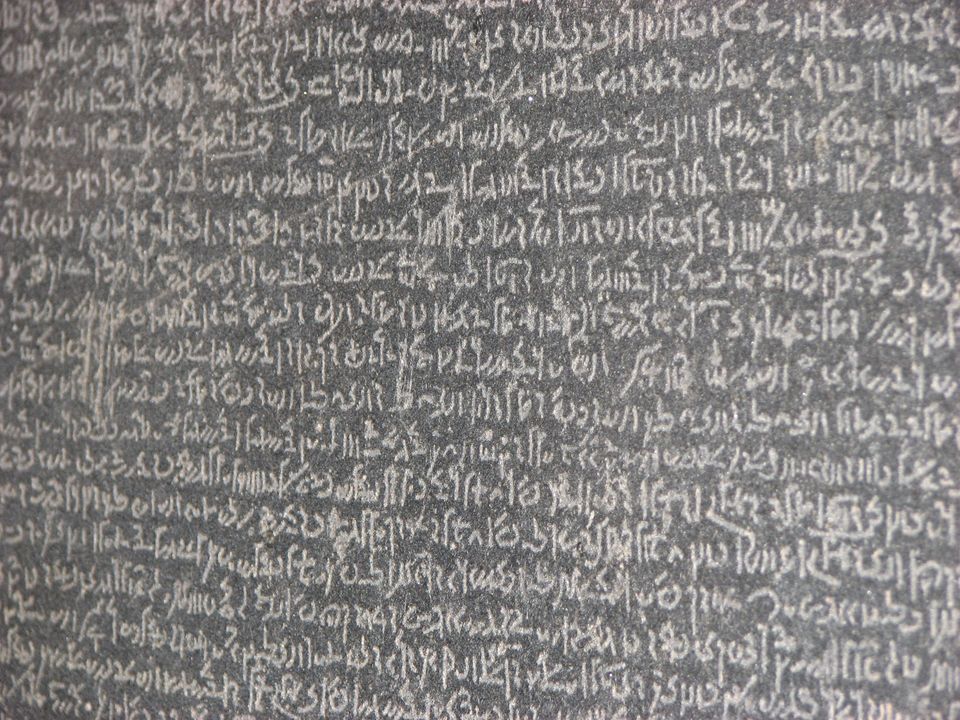
The most visited object in the British Museum is a broken slab of granodiorite bearing a priestly decree of 196 BC. Its fame rests not on its content but on the fact that the same content appears in three scripts.
Key points
- The Rosetta Stone, British Museum EA 24, is a granodiorite fragment 112.3 centimetres high weighing about 760 kilograms.
- The Rosetta Stone's decree was issued at Memphis on 27 March 196 BC by Egyptian priests honouring Ptolemy V Epiphanes, then thirteen.
- The Rosetta Stone's text survives in fourteen lines of hieroglyphs, thirty-two lines of Demotic and fifty-four lines of Greek.
- French soldiers found the stone at Rashid (Rosetta) in July 1799; it passed to Britain under the Capitulation of Alexandria and has been in the British Museum since 1802.
- Jean-François Champollion set out an alphabet of phonetic hieroglyphs in his "Lettre à M. Dacier", read on 27 September 1822.
The Rosetta Stone says, in substance, thank you to a king. It carries a decree passed at Memphis on 27 March 196 BC by a council of Egyptian priests honouring the thirteen-year-old Ptolemy V Epiphanes for remitting taxes and reducing the dues owed by temples, and the text is cut three times: in hieroglyphs, in Demotic and in Greek.
The Rosetta Stone is a fragment of a stele of dark grey granodiorite, 112.3 centimetres high, 75.7 wide and 28.4 thick, weighing about 760 kilograms, registered in the British Museum as EA 24. It carries a decree issued at Memphis on 27 March 196 BC by a council of Egyptian priests in honour of Ptolemy V Epiphanes, who had come to the throne as a child and was thirteen when the decree was passed. The text is cut three times: in Egyptian hieroglyphs at the top, of which fourteen lines survive; in Demotic, the cursive script of everyday Egyptian, in thirty-two lines; and in Greek, the language of the Ptolemaic administration, in fifty-four lines.
What does the decree actually say?
The content is administrative. The priests record the king's benefactions: he has remitted taxes and arrears, reduced the dues owed by temples, released prisoners, put down a rebellion in the Delta and paid for repairs to temples and irrigation. In return they decree that his statue is to stand in every temple, that his birthday and accession day are to be feasts, and that the decree is to be inscribed on a stele of hard stone "in sacred, native and Greek characters" and set up in temples of the first, second and third rank. Other copies of the same decree, complete where the Rosetta fragment is broken, have since been found, among them the stele of Nubayrah in Cairo.
The find and the treaty
The stone was found in July 1799 by French soldiers rebuilding a fort at Rashid, the town Europeans called Rosetta, on the western branch of the Nile, and was recognised as important by the engineer officer Pierre-François Bouchard. When the French army in Egypt surrendered to the British in 1801, Article 16 of the Capitulation of Alexandria required it to hand over the antiquities it had collected, and the stone went to London. It has been in the British Museum since 1802, with the painted inscriptions "Captured in Egypt by the British Army 1801" and "Presented by King George III" still on its sides. Egypt has asked for its return; the museum's position is that it is held under the British Museum Act.
The decipherment
The Greek could be read at once, which gave scholars the meaning of the other two texts without the means to read them. The English physicist Thomas Young established from the Demotic and the cartouches that some hieroglyphs recorded sounds, and read the name Ptolemy. Jean-François Champollion, working from copies in Paris, went further: in his "Lettre à M. Dacier" read to the Académie des Inscriptions on 27 September 1822 he set out an alphabet of phonetic hieroglyphs, and within two years he had shown that the script combined sound signs and meaning signs. Egyptian, which had not been read since late antiquity, became a language again.
Seeing it
The stone stands in a glass case in the museum's Egyptian sculpture gallery, unpolished since a cleaning in 1999 removed the carnauba wax and white chalk that had been applied to make the text legible; the pink vein of granite through the top corner is now visible. A full translation of the Greek and Demotic, and of what survives of the hieroglyphic, is published by the museum.
Frequently asked questions
Why is the Rosetta Stone written in three scripts?
The decree itself ordered that it be inscribed on a stele of hard stone "in sacred, native and Greek characters": hieroglyphs, Demotic, the cursive script of everyday Egyptian, and Greek, the language of the Ptolemaic administration. Copies were to be set up in temples of the first, second and third rank.
Who deciphered the Rosetta Stone?
The Greek could be read at once. Thomas Young established from the Demotic and the cartouches that some hieroglyphs recorded sounds, and read the name Ptolemy. Jean-François Champollion went further, setting out an alphabet of phonetic hieroglyphs in 1822 and showing within two years that the script combined sound signs and meaning signs.
How did the Rosetta Stone end up in London?
French soldiers found it at Rashid in July 1799. When the French army in Egypt surrendered to the British in 1801, Article 16 of the Capitulation of Alexandria required it to hand over the antiquities it had collected, and the stone has been in the British Museum since 1802. Egypt has asked for its return.